
Copy the snippet below and paste it between the tags of the page where your phone number appears, right after the Google tag
Road Building & Soil Stabilization

Road Building and Soil Stabilization in North Texas

Road building and soil stabilization form the foundation of durable driveways, access roads, and building pads that hold up under traffic. Redhawk Earthworks, LLC handles both services across Denton County and North Fort Worth, from private drives and ranch roads to job-site access lanes and stabilized building pads. Whether you need a new private road cut in with a compacted base or soil stabilization to strengthen loose or unstable ground, we build it with North Texas conditions in mind.

What Is Road Building and Soil Stabilization?

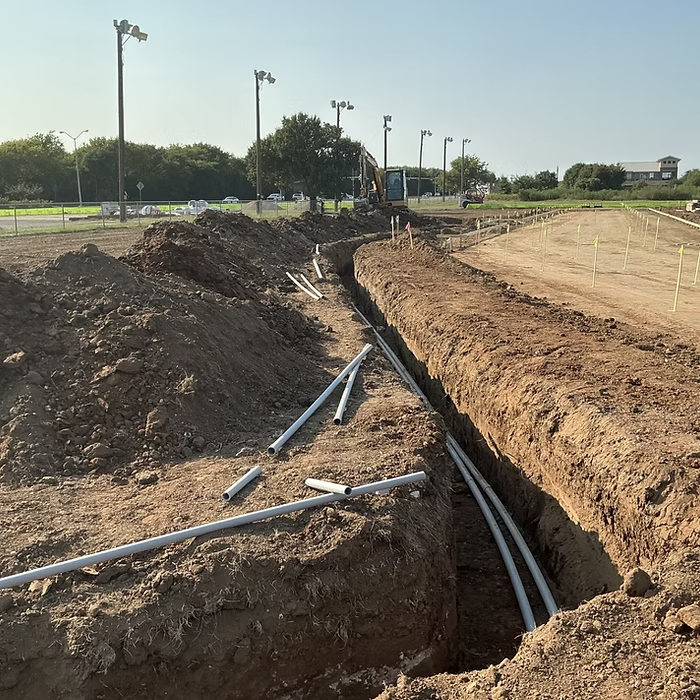
Road building and soil stabilization work together to create ground that can handle traffic, weather, and the demands of construction. Road building involves cutting, shaping, grading, and building a stable base for roads, driveways, access lanes, and building pads. Soil stabilization addresses weak or expansive ground by improving the soil’s strength and reducing movement caused by changing moisture conditions.

This matters throughout North Texas, where heavy rain, drainage problems, and expansive clay can lead to rutting, potholes, erosion, cracking, and uneven settling. Redhawk Earthworks, LLC prepares the subgrade, manages drainage, installs and compacts the appropriate base material, and can stabilize challenging soils when the site calls for it. Depending on the project, we also handle materials such as flexbase, caliche, and asphalt milling, along with spoil dirt hauling, so the site can be prepared and built up as part of one coordinated job.
What to Expect

How a Road Building or Soil Stabilization Job Works

Every road, driveway, or soil stabilization job starts with a look at the route and the ground underneath it.

Site Assessment. We evaluate the existing grade, drainage, soil, vegetation, and access points to determine what needs to be cleared, excavated, graded, or stabilized.

Clear Project Pricing. After assessing the site and materials required, you’ll receive a straightforward quote before work begins.

Scheduling & Preparation. We’ll coordinate a start date and make sure the necessary crew, equipment, and materials are ready for the job.

Road Building or Soil Stabilization. Road projects include excavation, grading, base placement, and compaction to create a stable driving surface. For stabilization, we test the soil, apply the appropriate lime or cement treatment, mix it to the required depth, and compact the subgrade to specification.

Testing & Final Grading. When testing is required, we coordinate with third-party labs to verify density and strength. Final grading, drainage slopes, and cleanup complete the work and leave the site ready for its next use.

Frequently Asked Questions

Road Building & Soil Stabilization FAQs

We handle road building and soil stabilization across Denton, Fort Worth, Krum, Justin, Decatur, Azle, and Ponder, plus Argyle, Flower Mound, Roanoke, Corinth, and Haslet.
Gravel offers good drainage and is typically less expensive, while caliche compacts into a harder, more durable surface that generally holds up better under heavier or more frequent traffic.
Most single-lane ranch and private roads run 12 to 16 feet wide, though width should account for the largest vehicles or equipment that will regularly use the road, including trailers and delivery trucks.
Yes. Where a road needs to cross a drainage path or low area, we install culverts sized to handle expected water flow so the road does not wash out during heavy rain.
Timelines depend on length and terrain, but most driveway or short access road projects take a few days, while longer ranch roads with multiple segments or drainage crossings can take one to two weeks.
Yes. Most rutting and flooding issues come down to poor crown, inadequate base material, or missing drainage. We evaluate the existing road and regrade or rebuild the base as needed to correct the problem.
For road building, pricing depends on length and width, base material chosen, clearing and grubbing required, soil conditions, and whether culverts are needed. For soil stabilization, cost depends on total treatment area and depth, type of stabilizing agent (cement costs more than lime), existing soil condition, site access, and compaction testing requirements. We provide a detailed estimate after reviewing conditions, so you know exactly what’s included before any equipment mobilizes.

Ready to Get Started?

Call today for a quote on your road building or soil stabilization project or your next load of material.
Scroll to Top